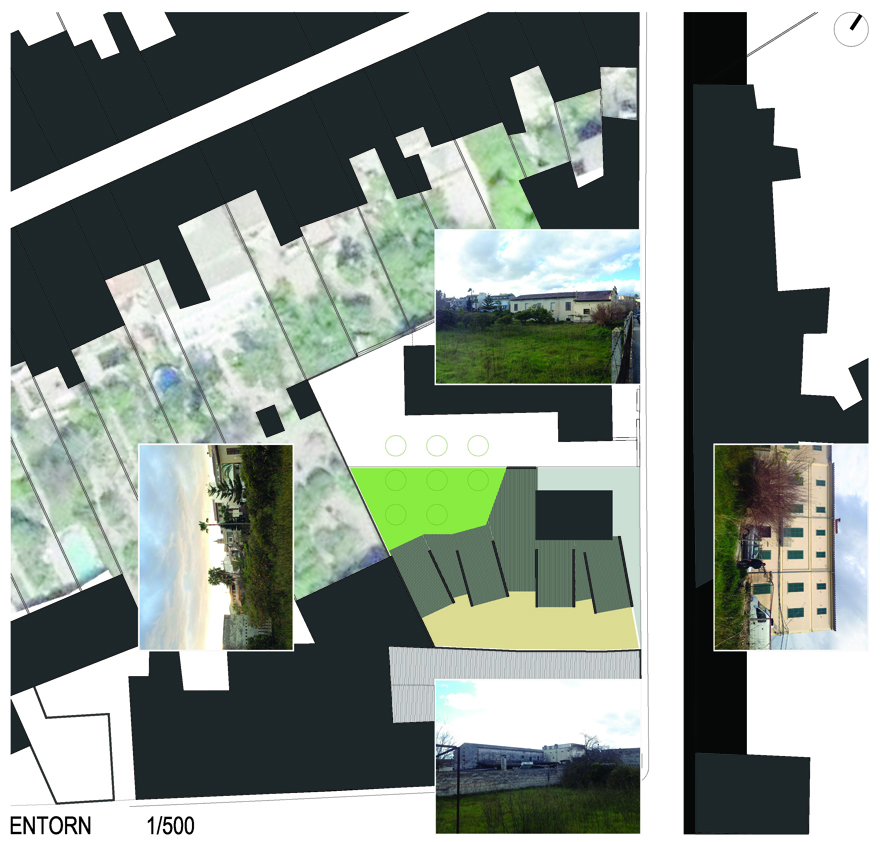
The site for the new kindergarten is located in the bottom of the small valley that separates the two historical nuclei of Llubí. In addition, the plot is 1 meter beneath the street level and it is surrounded by relatively high buildings that accentuate the confinement feeling that one can have on the site. Thus, in the same way of Llubí sloped roofs, the classrooms of the new kindergarten will raise their roofs to the sky, giving presence and dignity to the new building.
INTERIOR BLOCKS ALLEYS IN LLUBÍ
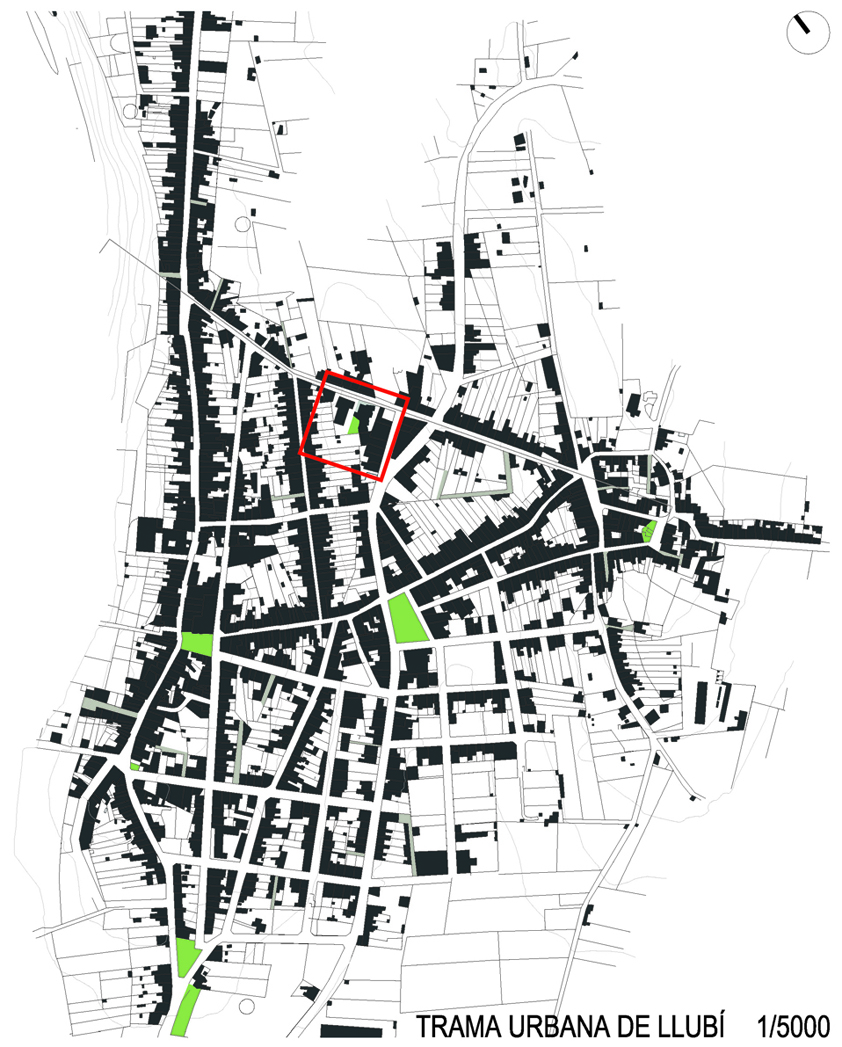
Llubí urban’s tissue has a low density: it is a patchwork of orchards and small buildings. This tissue is, moreover, porous: several alleyways penetrate through the blocks giving access to dwellings, garages and orchards.
The entrance to the new kindergarten will take place along an alley. This action will separate pedestrian access from the street and, at the same time, will connect the level of the street with the one of the kindergarten, reaching a new semi-public space for the town, placed on the back of the new building.
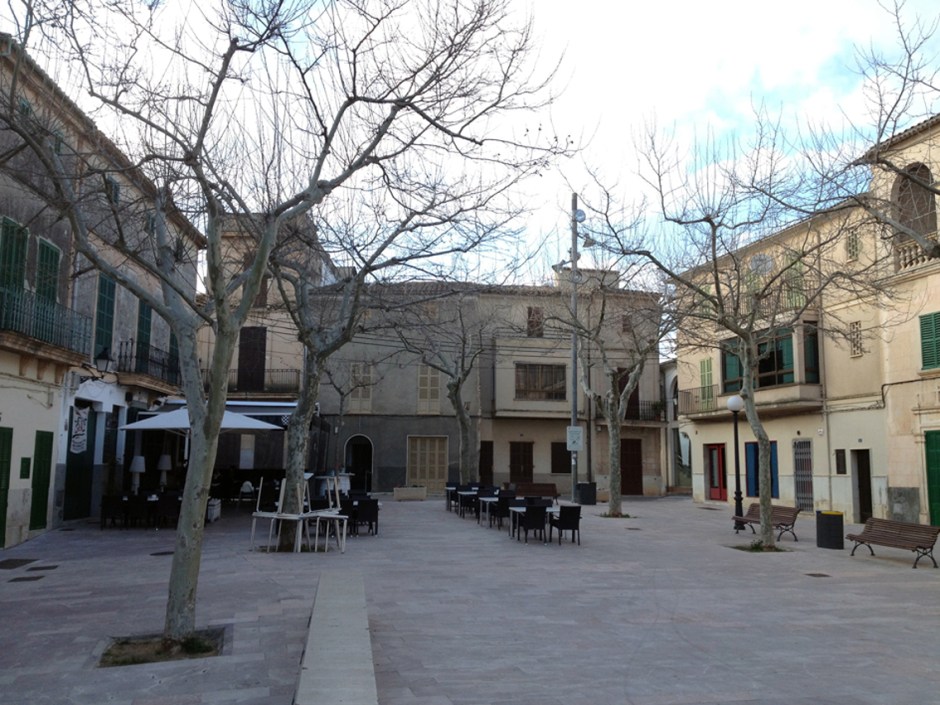
LLUBÍ PUBLIC SPACES
This new semi-public space will be located on the back of the kindergarten, where the plot is opened to the interior of the block, full of orchards and corrals, with the church’s tower as a backdrop. This garden, which during the school time will be used exclusively by the kindergarten children and teachers, will be opened to the town when the facility is closed as a space for interaction and play for children, parents and grandparents. Unlike other public spaces of Llubí, it is intended that this is not a paved plaza, but a small garden with permeable soil and some of the existing orange trees.
INFORMALITY
The irregular layout of the town buildings generates informal and perceptively interesting public and private spaces. Applying this model, four completely rectangular classrooms are projected, which, placed irregularly, generate interior and exterior spaces with unexpected perspectives, hidden corners, etc. In this way, it is intended to foster children’s imagination, curiosity and freedom, as well as their appropriation of the place.
MATERIALITY
While walking through the town, one can observes that most of the façades are made of natural stone, sandstone or are mortar rendered. These three elements will be the ones to materialize the façades of the new building: – A thick bundle of mortar with stones for the eight load-bearing walls; – Sandstone for the perimeter plot fences; – Mortar render for the compact block where the services of the kindergarten are placed and for the façades perpendicular to the structural walls.

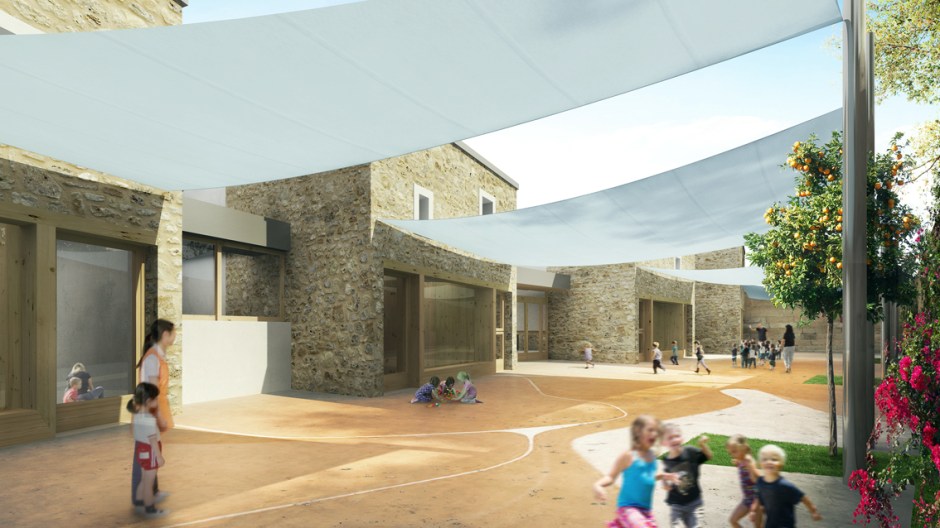 Kindergarten in Llubí, Mallorca







 Sistemes Operatius